Dear friends,
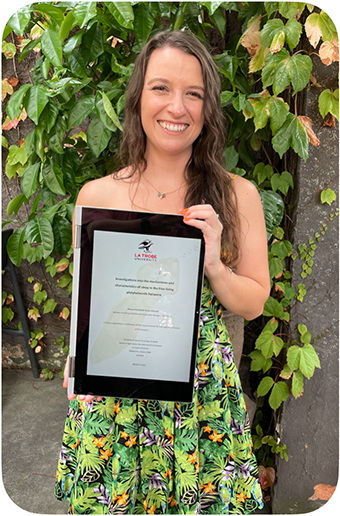
These are the moments that matter most. It is my pleasure to announce that Shauni Omond’s PhD entitled, “Characteristics and mechanisms of sleep in the free-living platyhelminth flatworm” was passed following peer-review without the need for any amendments. Incredible!
Shauni is well known in our School of Agriculture, Biomedicine & Environment. She served as the Departmental Post-graduate Student Representative for Ecology, Environment and Evolution, and later elevated to the School Representative. She has worked with Heads of Department, the School Executive, and the Graduate Research School as a colleague and selfless ambassador for the interests of post-graduate students.
During her time at La Trobe University, Shauni conducted wholly original research. When Shauni started in the lab as an Honours student in 2015, our understanding of sleep was limited to vertebrates, a handful of arthropods and mollusks, and C. elegans. All other animal phyla (32 or so at that point) had been unstudied.
Shauni opted to explore the presence and regulation of sleep in an animal untapped by sleep scientists: free-living platyhelminth flatworms. In a series of behavioural assays, Shauni demonstrated that restful flatworms are sleeping flatworms as reflected by postural changes, reduced responsiveness, and homeostatic regulation (Omond et al. 2017 Sleep). This paper constituted the high-impact output of Shauni’s first-class Honours thesis. It is noteworthy that at the time of her Honours submission, data collection for the sleep deprivation study was incomplete and, to her great credit, Shauni remained in the lab for another four months to ensure high-quality data worthy of publication.
For her PhD (2018-2023), Shauni delved into the physiology underlying the sleep state of flatworms. Most impressively, she created a method to administer neurotransmitters to flatworms, and did so, for four neurotransmitters that promote wakefulness in mammals (acetylcholine, dopamine, glutamate, histamine), and three that induce sleep (adenosine, GABA, serotonin); she also gave flatworms the histamine receptor antagonist, pyrilamine. Each compound was given at concentrations spanning at least three (and often more) orders of magnitude. Total sample size: 504. Ultimately, she found that simple flatworms bear a simplified complement of neurotransmitters, with only three of them regulating sleep/wake states. Still, those three (dopamine, histamine, GABA) had an evolutionarily conserved effect on sleep/wake states across flatworms, fruit flies, and various vertebrates. The result for her? A second paper in our highest impact journal (Omond et al. 2022 Sleep).
A wonderful, ancillary value of this paper is that her work provided a means to reduce, and augment, sleep in flatworms pharmacologically. Shauni sought to measure the metabolic consequences of sleep using a Seahorse respirometer. Consistent with energy savings observed during sleep in other animals, GABA-treated flatworms showed reduced oxygen consumption relative to flatworms exposed to (wake-promoting) dopamine, and animals exposed only to untreated spring water (Omond et al. in preparation). Thus, the behavioural restfulness that characterises sleep in flatworms is mirrored by physiological downregulation.
Shauni went on to explore a peculiar ability of flatworms: their remarkable ability to regenerate the entire animal from mere slivers of the parent. To do so, Shauni measured daily activity patterns of intact flatworms and then again after decapitation in headless tails and tailless heads, and again still in regenerated animals. She found that each one-half of a flatworm retains (1) the ability to move and (2) their nocturnal lifestyle (Omond et al. 2023 J Biol Rhythms). Shortly after data collection was complete, a paper published in PNAS found that flatworms sense light using their well-known eye-spots in their head, but also extraocular photoreceptors diffusely located across their body. And so, Shauni had described the behavioural output arising from these photoreceptors.
To advertise the importance of her findings, and explain the promising future of flatworms in sleep research, Shauni summarized her studies in a review paper (Omond et al. 2023 J Comp Physiol B). In addition to these efforts, Shauni also co-authored two other papers: one on the experience of PhD students during COVID-affected years (Atkinson et al. 2021 High Educ Res Dev) and another on the role of sleep tracking technology for (non-flatworm) professional (human) athletes (Driller et al. 2023 Sports).
Together, these seven papers involved her forming collaborations with members of the School of Psychological Sciences (Matthew Hale), School of Allied Health (Matt Driller), and SABE (Paul Fisher, Sarah Annesley, Oana Sanislav).
Her efforts were recognized by two referees that passed her PhD without changes, with one of them stating:
I congratulate the candidate on producing some exceptional and very interesting work that has a huge amount of potential for the understanding of sleep and circadian rhythms in the future. I particularly enjoyed reading a thesis about a critter that was not a genetically manipulated rat or mouse, what a breath of fresh air!
Congratulations, Shauni Omond, PhD! I can’t wait to see what comes next for you.
 Sleep Ecophysiology Group
You must be logged in to post a comment.