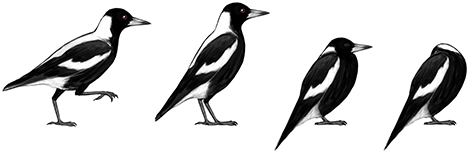
The Sleep Ecophysiology Group studies sleep behaviour and neurophysiology in diverse animals, including mammals, avian and non-avian reptiles, fishes, and invertebrates, often in naturalistic or wild environments. Using this strong comparative approach that integrates behavioural ecology with neuroscience, we aim to provide insight into:
(I) The evolution of sleep and sleep state components
(II) The causes and consequences of inter- and intra-specific variation in sleep duration
(III) Animals that forgo sleep when competing demands favour extended wakefulness
(IV) The role of ecological factors, such as predation risk, in determining where, when and how long animals sleep
(V) Local aspects of sleep
(VI) Sleep-dependent cognition in birds
(VII) The effects of pollution (light and sound) on sleep in birds
The research interests of each group member can be found below.
Lab Head
A/Prof John Lesku
 I strive to provide insight into how sleep and sleep functions have evolved in different types of animals, from flatworms to birds and mammals. I also study how ecological factors (e.g., predation risk, reproduction) influence the amount, composition, depth and timing of sleep. Most recently, these interests have expanded to include how anthropogenic pollution influences sleeping brain activity in mammals, birds, and fishes.
I completed my B.Sc. in zoology at the University of Guelph (Canada) in 2002. I then did a MSc with Drs Charles Amlaner and Steven Lima at Indiana State University (USA) (2003-2006). This work consisted mostly of phylogenetic comparative analyses of sleep quotas as a means for testing interspecific support for various non-exclusive hypotheses for the functions of sleep. These, and other, studies provided evidence that the risk of predation can reduce the amount of rapid eye movement (REM) sleep over both evolutionary and ecological timescales, in prey. From there I joined the Avian Sleep Group of Dr Niels Rattenborg at the Max Planck Institute for Ornithology – Seewiesen (Germany). My PhD focused on the evolution and regulation of sleep states in birds (2007-2011). I stayed in Seewiesen for the remainder of 2011 as a postdoc. Working with Drs Rattenborg and Mihai Valcu, and Prof Dr Bart Kempenaers, we studied breeding pectoral sandpipers on the tundra in Barrow, Alaska; work that provided the first direct evidence that sleep loss can be evolutionarily adaptive. For my contributions to this group effort, I was given the Young Investigator Award by the Sleep Research Society (USA). After 5 wonderful years in Germany, I took up a University Postdoctoral Research Fellowship at The University of Western Australia (2012). Soon thereafter I was offered a continuing position at La Trobe University, which I commenced in 2013. From 2014-2017, I was an Australian Research Council (ARC) Discovery Early Career Researcher Award (DECRA) Research Fellow. Throughout 2020, I was the Acting Head of Department of Ecology, Environment and Evolution. I was promoted to Associate Professor in 2021.
Doctoral Students
Hannah Elmes, La Trobe University, Sleep functions in flatworms (2025-Ongoing)

Hannah will expand upon our (mostly) behavioural work on sleeping flatworms to identify sleep processes; notably, visualising brain activity, memory processing, and DNA damage and repair. To do so, she’ll collaborate with Tal Shomrat (Hebrew University of Jerusalem), Lior Appelbaum (Bar-Ilan University), and Patrick Humbert and Donna Whelan (La Trobe University).
Ethan Renner, University of Auckland, The physiology of sleep in elasmobranchs (2024-Ongoing)

Working closely with Prof Craig Radford at the Leigh Marine Laboratory in New Zealand, Ethan will explore the physiology of sleeping sharks, including metabolic changes and electrophysiological correlates with special emphasis on eye movements and brain activity. Starting with benthic species, such as carpet sharks and rays, he hopes to ultimately understand how fishes that swim continuously achieve their daily amount of sleep.
Vincent Knowles, The University of Melbourne, Spatial and temporal ecology of Cape Barren geese on Phillip Island (2024-Ongoing)
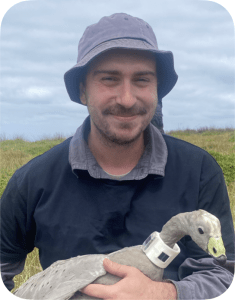 Vincent is based at The University of Melbourne with Prof Raoul Mulder and, in partnership with Phillip Island Nature Parks, is conducting intensive fieldwork on Phillip Island to enable evidence-based decision making in the management of Cape Barren geese.
Fledged PhD Students
Dr Erika Zaid, La Trobe University – To sleep or not to sleep: can mating dasyurids provide insight into the evolution and function of sleep? (2016-2024)
Even while it is accepted that reduced performance is an inevitable outcome of sleep loss, some animals may perform well on little sleep when ecological demands favour extended periods of wakefulness. One of the best mammal candidates for such sleeplessness is antechinus, as these marsupials die synchronously after just one intense mating season. Using video recordings, accelerometry, electrophysiology, endocrinology, and metabolomics, Erika examined the activity patterns of antechinus before and during the breeding season.
Dr Shauni Omond, La Trobe University – Characteristics and mechanisms of sleep in the free-living platyhelminth flatworm (2018-2023)
Sleep is widespread across animals, but research focusses on just a few animal phyla. Shauni’s PhD explored the behavioral, neurochemical, and physiological correlates of sleep in platyhelminth flatworms. She found that sleep in these simple invertebrates is regulated by prior sleep/wake history and by the evolutionarily conserved neurotransmitter, GABA. Furthermore, flatworms exposed to GABA have a lower metabolic rate than those exposed to wake-promoting dopamine. Thus, sleep in flatworms is not so different from that observed in more derived taxa, opening the door for flatworms as a new animal model for sleep research.
Dr Robin Johnsson, La Trobe University – Cognition and sleep in Australian magpies (2018-2022)
Advanced cognition is a key trait enhancing the fitness of many wild animals. Maintaining the neural mechanisms for advanced cognition, including specialized memory, is energetically expensive, and is critically dependent on sleep. Robin’s dissertation provided insight into (1) the regulation of sleep in Australian magpies, (2) evidence for tool-use, and (3) means-end understanding, and (4) that cognition depends upon the duration of prior sleep. Robin is now a postdoc in the USA working with Dr Timothy Roth at Franklin & Marshall College.
Dr Michael Kelly, The University of Western Australia – An investigation into sleep in sharks: behavioural and electrophysiological approaches (2016-2020)
Sleep is widespread across the animal kingdom. Some animals, including mammals and birds, have two types of sleep. Recent studies have identified two kinds of sleep some reptiles and zebrafish. Surprisingly, data on the simple presence of sleep in sharks, the earliest group of jawed vertebrates, has been wholly lacking. Mike’s dissertation offered integrative investigations into the diversity of activity patterns in sharks, as well as behavioural and physiological evidence for sleep in elasmobranchs, using measures of muscle tone, metabolic rate, and brain activity.
Dr Farley Connelly, The University of Melbourne – Impacts of anthropogenic pollution on cognition and sleep in an urban bird (2016-2020)
Urban areas worldwide are expanding at unprecedented rates, often with devastating consequences to wildlife. Humans generate various forms of urban pollution that impact wildlife, including anthropogenic noise and artificial light at night. The effect such pollutants have on wildlife physiology and behaviour has been extensively studied, but their impact on cognitive performance and sleep remained poorly understood. Utilizing wild and captive Australian magpie populations, Farley explored the effect anthropogenic noise on cognitive performance, as well as the impact noise and artificial light night have on sleep.
Dr Anne Aulsebrook, The University of Melbourne – Impacts of streetlights on sleep in urban birds (2015-2019)
Increasing artificial light at night (ALAN) is one of the most rapid and pervasive changes to our natural environment. Nevertheless, the consequences of ALAN for wildlife are only beginning to be understood. A likely impact of ALAN is the disruption of endogenous daily rhythms, or circadian rhythms, including the sleep-wake cycle. Anne’s PhD research investigated the impacts of ALAN on sleep and melatonin profiles of two urban bird species, the black swan (Cygnus atratus) and the pigeon (Columba livia). She is now a Marie Curie Fellow at the Max Planck Institute for Ornithology, Seewiesen, Germany.
Masters Students
Vincent Knowles, The University of Melbourne – Pair proximity and behavioural synchrony in the socially monogamous black swan (2021-2023)
Honours Students
Hannah Elmes – Age-dependent changes in neuron count and volume in the hippocampal formation of racing pigeons (Columba livia) (2024)
Sophia E. Lee – Cartilaginous fishes: challengers to the behavioural definition of sleep (2023)
Brayden J. Redwood – Increased activity of dusky antechinus (Antechinus swainsonii) males during the breeding season (2018)
Chris Vapp – Effects of decapitation and regeneration on the activity patterns in planaria flatworms (Girardia tigrina) (2018)
Linh Ly – Activity patterns in jellyfish (2017)
Shauni Omond – Searching for sleep in an evolutionarily simple bilaterian (2016)
Danielle Eastick – The thermoregulatory role of the southern cassowary’s (Casuarius casuarius) casque (2014)
Michael Kelly – Unilateral eye closure as an anti-predator behavior in juvenile saltwater crocodiles (Crocodylus porous) (2014)
Laura Tieri – Absence of local sleep homeostasis-like patterns under isoflurane anaesthesia in the pigeon (Columba livia) (2014)
 Sleep Ecophysiology Group
You must be logged in to post a comment.